Electrical Planning for Future Business Growth
Learn how electrical capacity planning helps businesses prepare for growth, support new equipment, prevent disruptions, and meet future power demands.
Read More
Data centers are running hotter than ever as AI, cloud computing, and high-performance workloads continue pushing infrastructure to new limits.
More power means more heat, and traditional air-cooling systems are struggling to keep up with modern demand.
That shift is driving rapid adoption of liquid cooling systems across the industry. What was once considered a specialized solution is quickly becoming the new standard for high-density data centers.
Liquid cooling is stepping in as the new standard.
Cooling is no longer just a support system inside the data center. It directly impacts performance, uptime, efficiency, and long-term scalability.
As rack densities increase, heat builds faster.
If that heat is not managed, systems slow down or fail.
That creates risk:
Cooling is now a core part of data center design.
Liquid cooling is not simply a mechanical upgrade. It changes how the entire data center operates from an electrical standpoint.
As facilities increase computing density and install advanced cooling systems, power infrastructure must evolve alongside them. In many cases, existing electrical systems were not designed to support the demands created by modern liquid cooling environments.
Higher Power Demand
AI workloads and high-density computing require significantly more power per rack than traditional environments.
That increase impacts:
Facilities must be designed to deliver larger amounts of reliable power while maintaining uptime and redundancy.
New Cooling Infrastructure Requires Power
Liquid cooling systems introduce entirely new equipment into the facility.
Pumps, heat exchangers, monitoring systems, and cooling distribution units all require electrical integration and continuous operation. As these systems expand, so does the complexity of the facility’s electrical design.
This is one reason why electrical planning now plays a much larger role in data center cooling projects.
Reliability Is Critical
Data centers cannot afford downtime.
Cooling systems and electrical systems must work together to maintain continuous operation, especially in high-density environments where temperatures can rise quickly during a disruption.
That is driving increased focus on:
For many facilities, liquid cooling is also becoming a long-term electrical infrastructure investment, not just a cooling upgrade.
For years, traditional air cooling systems handled the needs of most data centers effectively. But modern facilities operate at a completely different scale.
Higher rack densities and AI-driven workloads now generate far more heat than older environments were designed to support, placing significant pressure on conventional cooling infrastructure.
High-density racks produce more heat than air can handle efficiently.
Air systems:
As demand increases, these limits become more expensive.
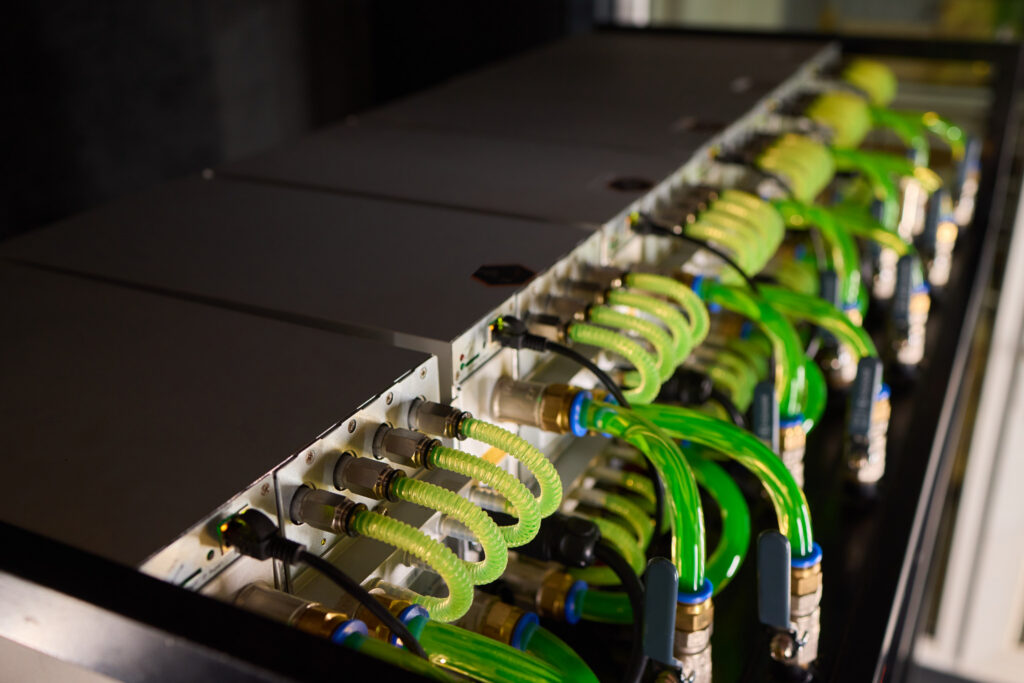
Liquid cooling removes heat using fluid instead of air.
Liquids absorb heat faster and move it more efficiently.
There are two main approaches:
Direct-to-Chip Cooling
Coolant flows directly to processors and GPUs.
Heat is removed at the source.
Immersion Cooling
Equipment is placed in a specialized liquid.
The fluid absorbs and dissipates heat.
Both methods deliver higher performance than air systems.
This shift is not optional.
It is driven by real operational needs.
Higher Density Support
Modern workloads require more power per rack.
Liquid cooling supports higher densities without overheating.
This is essential for:
Better Energy Efficiency
Cooling is one of the largest energy costs in a data center.
Liquid cooling reduces that load.
It requires less energy to move heat.
It reduces reliance on large HVAC systems.
That leads to lower operating costs.
Stronger Sustainability
Efficiency and sustainability go together.
Lower energy use reduces carbon output.
Many companies are now required to meet sustainability goals.
Cooling systems play a major role in that effort.
Liquid cooling also opens the door for heat reuse.
More Usable Space
Air cooling requires large mechanical systems.
Liquid cooling reduces that footprint.
That allows:
The shift to liquid cooling is accelerating.
Investment is increasing across the industry.
Companies are redesigning facilities to support higher performance and better efficiency.
Waiting creates problems:
Early adoption creates an advantage.
Cooling decisions now affect nearly every part of a data center project, from electrical infrastructure and power distribution to facility design and long-term scalability.
Because of this, planning must happen early. Delays in infrastructure upgrades can limit performance, increase costs, and slow future expansion.
To support the transition:
Plan early
Cooling and power must be designed together.
Design for density
Future workloads will require more capacity.
Upgrade electrical systems
Power infrastructure must support new loads.
Focus on efficiency
Better systems reduce long-term costs.
Think long term
Cooling decisions impact future growth.
Data centers are entering a new phase.
Higher density, higher demand, and higher expectations.
Air cooling is no longer enough for many environments.
Liquid cooling is becoming the standard.
Businesses that move now will be better positioned for what comes next.
The Bottom Line
Liquid cooling is becoming essential for modern data centers that need to support AI, high-density computing, and long-term growth.
The facilities investing now are positioning themselves for better performance, lower energy use, stronger scalability, and more reliable infrastructure in the years ahead.
The shift is already happening.
The question is how quickly businesses adapt.
Ready to Build Smarter Data Center Infrastructure?
Cooling and power must work together to support modern workloads.
Our team helps design and build electrical systems that support high-density environments and advanced cooling technologies.
Schedule a consultation today to plan your next data center upgrade.